From Canvas to Stage with Paul Boyd
Inspired by the evocative world of Australian painter Jeffrey Smart, Paul Boyd's Life's Roadmap explores the stories that exist between moments. Drawing on recurring figures and themes found throughout Smart's paintings, Boyd has created a deeply human work that reflects on youth, ageing, memory and the paths we travel through life. We spoke with Paul about the inspiration behind the ballet and the artistic journey of bringing it to the stage.
Header Image Credit -
Trumper Park (1961)
Private Collection
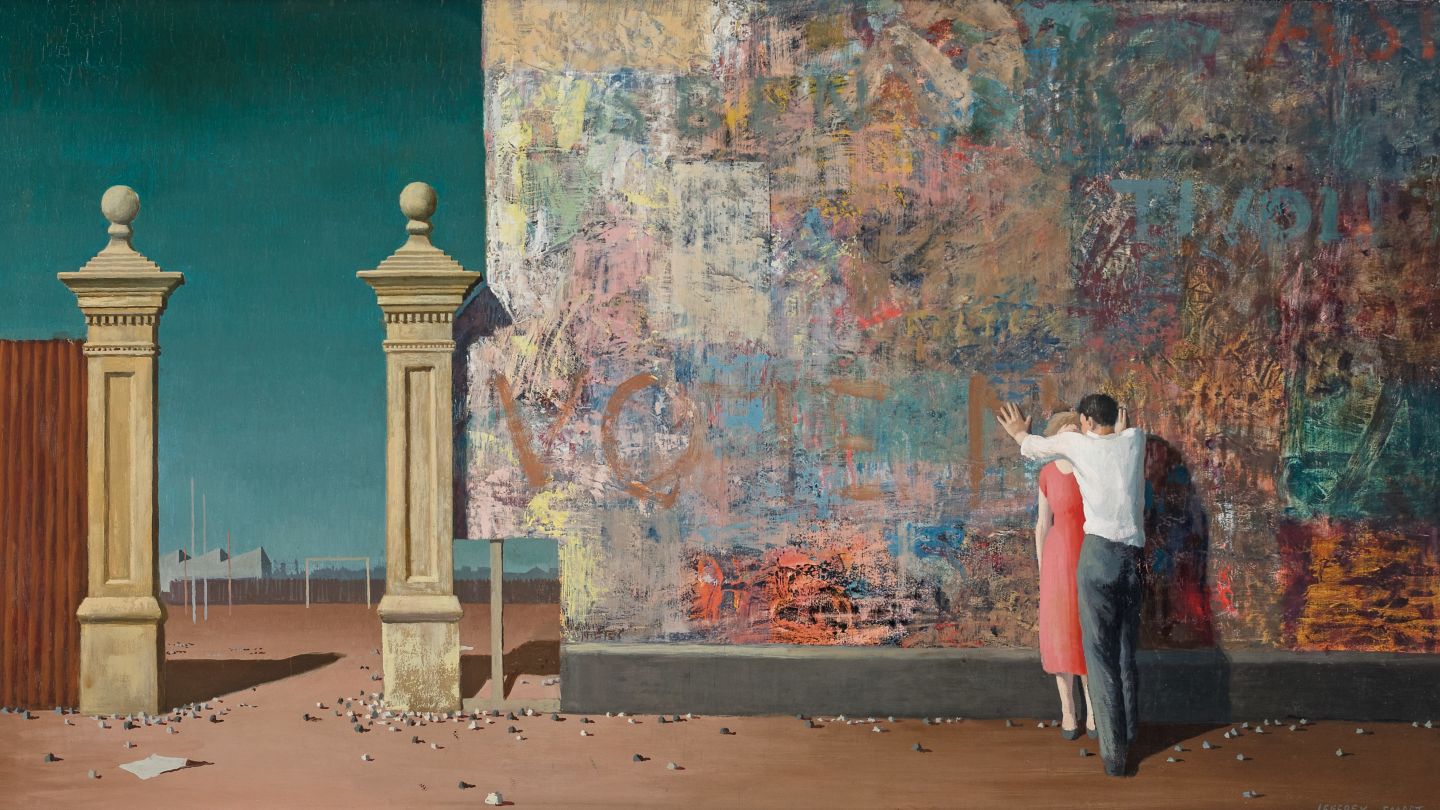
It all started with Jeffrey Smart. I reached out to Philip Bacon, who has been incredibly generous to me over the years, and asked if he had any books I could study. I knew that whatever Philip recommended would be an authentic window into Smart's world.
He lent me four beautiful books, and that's really where the inspiration began. I spent hours looking through the paintings, absorbing the compositions, the colours and, most importantly, the people.
The work is inspired by around ten of Jeffrey Smart's paintings, all featuring this recurring older man. Rather than presenting them as separate scenes, I'm imagining them as moments in one person's life. There is also a woman who appears throughout—my 'lady in yellow'—who becomes another thread connecting the story.
There's a quiet sadness about him, but also something deeply sympathetic. He has a presence that stays with you.
I don't want to give too much away just yet, but I kept asking myself: how do I capture that feeling on stage when I'm working with 11 young dancers? That became the creative challenge, not recreating the paintings literally, but finding the emotional world that sits beneath them
The level of detail in Jeffrey Smart's paintings is extraordinary. The tailoring of the suits, the architecture, the landscapes—every element feels so carefully considered that they become part of the character's personality.
As I immersed myself in his work, I spent time exploring material from the National Gallery in Canberra, reading about Smart's life and his paintings. I found myself continually drawn to this recurring older man who appears throughout so many of the works.
He seems to be on a journey. You find yourself asking, Where is he going? What is he searching for? Often he's accompanied by the woman in yellow, and together they seem to arrive at these emotional crossroads. I found that incredibly poignant and beautiful.
That's become the emotional starting point for the ballet. Rather than simply recreating Smart's paintings, we're imagining the life that exists between them.
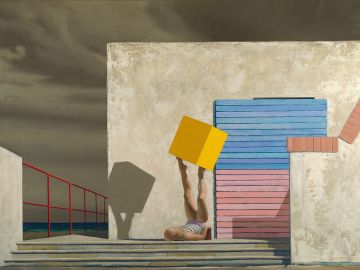
Morning Practice, Baia (1969)
Private Collection
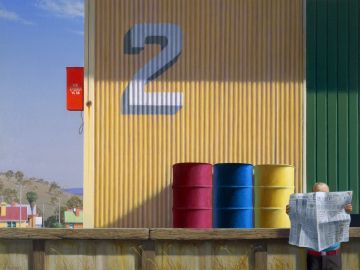
Morning, Yarragon Siding (1983-84)
Private Collection
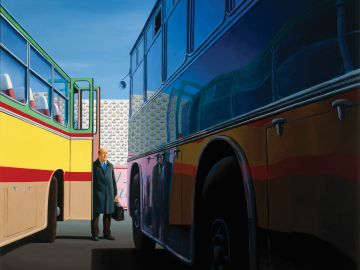
The Traveller 1973
Queensland Art Gallery
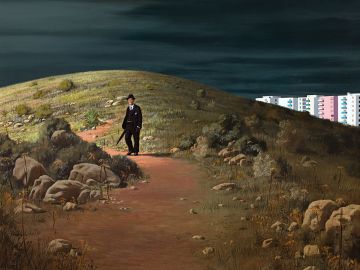
The Walker I 1965
Private Collection
I kept asking myself, how do I portray age on stage without it looking theatrical or artificial? That led me to investigate incredibly realistic prosthetic masks. So I explored what was possible and whether I could create something so lifelike that the audience would simply accept it.
There's one Young Artist who is proving himself to be an extraordinary actor, Gabriel Lowe who plays the Wolf in Little Red Riding Hood. He's so instinctive that I've had to give him far less direction than I expected. I trust him completely to carry this journey.
I've told Gabe, 'I don't want you dancing like a young man.' He has to inhabit the body of someone much older. It's in the stance, the way he walks, the weight he carries, the way he pauses before moving. Those physical details are just as important as the choreography in bringing this character to life.
We haven't started rehearsing in the studio yet, and everything changes once the dancers begin moving, but the idea is to follow this man through the adventures of his life.
As a choreographer, I'm always thinking about the dancers too. How can I create movement that allows these young artists to shine while still serving the story? That balance is really important.
One of the recurring images is a series of chairs. Rather than seeing them simply as props, I began imagining them as different personalities or different stages in a person's life. They become partners in their own right, creating opportunities for solos, pas de deux and shifting relationships on stage.
There's also a beautiful sequence by the sea, danced by the younger cast, which captures a sense of freedom, possibility and first love.
As I'm getting older myself, I've started thinking about that longing to experience youth again, if only for a moment. At the end of the work, the old man gradually peels away his prosthetics and outer layers while the other dancers gently undress him. It's an image of vulnerability—almost as though he's shedding the weight of a lifetime.
In the final moments, he returns to an image of youth, standing alongside a young woman in a beautiful, almost dreamlike tableau. For me, it's about reclaiming that final memory of who you once were. The image is also a quiet nod to T.S. Eliot and his reflections on ageing, memory and the passing of time.
For me, that's the heart of the ballet. It's a journey through memory, love and the passing of time, ending with one final chance to reconnect with the person he once was.
“Each art form elevates the others, creating something far greater than any could achieve alone.”
The score is primarily by Josef Suk, who was Antonín Dvořák's son-in-law. It's chamber music, and you can certainly hear echoes of Dvořák in it, but it has its own distinctive voice. The first time I heard it, I was genuinely moved. It's incredibly beautiful and full of emotion.
Working with Camerata is one of the great joys of this project. They are extraordinary musicians. The only challenge is timing—we don't actually hear them live until just a few days before opening. We'll have a rehearsal together, then suddenly we're on stage performing. It means everyone has to arrive exceptionally well prepared, but that's part of the excitement of live theatre.
Alongside Josef Suk's chamber music, I've also chosen a Puccini piece. It creates a moment where we glimpse this man's deep love of art, music and opera. I thought it was a beautiful way to open another window into his inner life.
What I love most about Soiree is the collaboration. To work with Jeffrey Smart's paintings, with Philip Bacon Galleries, and with Camerata feels incredibly special. It reminds me of Sergei Diaghilev, the great impresario behind the Ballets Russes, who brought together the finest artists, composers, designers and choreographers of his time. Works like The Rite of Spring forever changed what ballet could be because they fused different art forms into something entirely new.
That's always inspired me. I love that kind of artistic fusion—the dialogue between music, visual art and dance. Each art form elevates the others, creating something far greater than any could achieve alone.
Camerata are exceptional. Their musicianship is extraordinary, and they brought such beauty to Strings. Philip Bacon has nothing but admiration for them. I remember him turning to me after one performance and saying, 'My God, Paul, that was fantastic.'
I think Philip genuinely enjoys seeing artists push boundaries, and so do I. More choreographers and artistic directors are embracing collaborations across different disciplines because the creative possibilities are endless. Why wouldn't you? Once you open the door to other art forms, the scope of what you can create becomes so much richer.
Soirée is running from the 24th to the 26th of September 2026 at the Talbot Theatre, Thomas Dixon Centre.